IEP Compliance Checklist: Timelines, Deadlines and Audit Readiness

Updated: 2 days ago
An IEP compliance checklist gives your district one shared list of the federal timelines, notices and document contents every Individualized Education Program must meet, so compliance never depends on one case manager's memory. Most findings in a monitoring visit do not come from bad intent. They come from a missed date, a notice that went out late or a goal no one can measure. This guide sets out the deadlines IDEA requires, what reviewers look for in a file and how to build a routine that keeps your team audit-ready all year.
What an IEP compliance checklist covers
A useful checklist is organized the way an audit is: by requirement, not by form. Build yours around five areas:
Timelines: referral, evaluation, eligibility, IEP development, annual review and reevaluation dates.
Notices and consent: meeting notices, prior written notice, procedural safeguards and signed consent.
IEP contents: every element 34 CFR 300.320 requires, completed for every student.
Service delivery: minutes provided against minutes written, by provider and setting.
Progress reporting: data tied to each goal and reports sent to families on the schedule the IEP states.
If you are also tracking Section 504 plans, keep them on a separate list. They come from a different law with different documentation rules; our 504 plan vs IEP guide covers the differences.
The federal timelines every district must track
IDEA sets the floor. Many states set shorter or different timelines, so confirm each date against your state education department's rules before you build alerts around it.
Referral to eligibility
Consent first: the district must obtain informed parental consent before conducting an initial evaluation (34 CFR 300.300).
Initial evaluation: completed within 60 days of receiving parental consent, or within the timeframe your state establishes (34 CFR 300.301(c)).
Eligibility to a written IEP
IEP meeting: held within 30 days of the determination that the student needs special education and related services (34 CFR 300.323(c)).
Services start: as soon as possible after the IEP is developed.
Start of the year: an IEP must be in effect for each eligible student at the beginning of each school year.
Reviews and reevaluations
Annual review: the IEP team reviews each IEP periodically, and not less than once a year (34 CFR 300.324(b)).
Reevaluation: at least once every three years unless the parent and district agree it is unnecessary, and not more than once a year unless they agree otherwise (34 CFR 300.303).
Discipline
Manifestation determination: within 10 school days of any decision to change a student's placement because of a code-of-conduct violation (34 CFR 300.530(e)).
Notices, consent and parent participation
Procedural steps are where files most often look incomplete, because the work happened but the paper trail did not. Check that each file shows:
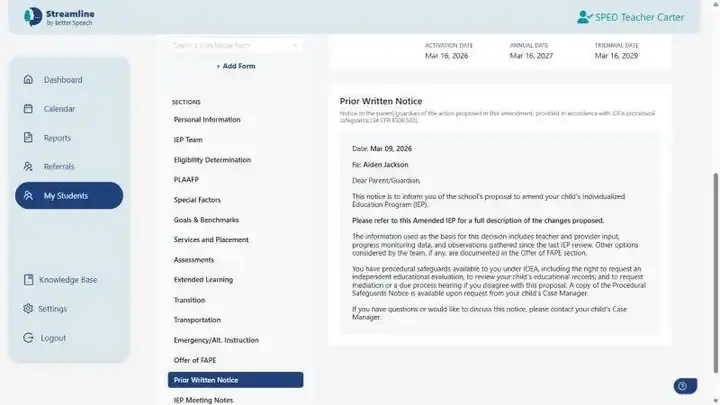
Meeting notice: sent early enough for parents to attend, stating the purpose, time, location and who will be there (34 CFR 300.322).
Prior written notice: given a reasonable time before the district proposes or refuses to change identification, evaluation, placement or the provision of FAPE (34 CFR 300.503).
Procedural safeguards notice: given once a year, and also at initial referral or parent request for evaluation, at the first complaint or due process filing, on a disciplinary change of placement and on request (34 CFR 300.504).
Parent copy: a copy of the IEP given to the parent at no cost.
Clear, documented communication also lowers the risk of disputes. See our tips for reducing due process complaints.
What every IEP must contain
Under 34 CFR 300.320, each IEP must include the elements below. Score every file against the full list, not a sample of it.
Present levels: academic achievement and functional performance, including how the disability affects progress in the general curriculum.
Measurable annual goals: academic and functional. Our guide to writing measurable IEP goals has examples by area.
Progress measurement: how progress toward each goal will be measured and when periodic reports will go to parents.
Services: special education, related services and supplementary aids, with projected start date, frequency, location and duration.
Participation: an explanation of the extent, if any, to which the student will not participate with nondisabled peers.
Assessments: accommodations for state and district assessments, or the reason an alternate assessment is appropriate.
Transition: measurable postsecondary goals and transition services, beginning not later than the first IEP in effect when the student turns 16, or younger if the state or IEP team decides.
Service delivery and progress reporting
An IEP can be complete on paper and still out of compliance if services do not happen as written. This is where districts carry the most financial exposure, as our post on the real cost of IEP non-compliance explains.
Service delivery
Minutes log: minutes delivered against minutes written, by student, provider and setting.
Missed sessions: each one recorded with a reason and a make-up plan.
Staff access: the IEP is accessible to every teacher and provider responsible for it, and each knows their specific responsibilities (34 CFR 300.323(d)).
Coverage plans: a named backup when a provider position is vacant or a provider is on leave.
Progress reporting
Data in the goal: data points attach to the goal they measure, not to a separate spreadsheet.
On-schedule reports: reports go to families when the IEP says they will, such as with report cards.
Decisions on the record: when data show a student is not on track, the file shows what the team did about it.
For a deeper workflow, see our guide to IEP progress monitoring.
Spend less time chasing deadlines and more time on students. See how Streamline supports IEP goal writing and SLP coverage alongside your current IEP system. Book a demo →
Common gaps that lead to findings
Most compliance problems trace back to a short list of preventable gaps. Look for these first in any internal review:
Late dates: annual reviews or three-year reevaluations held after the due date.
Unmeasurable goals: goals with no baseline, no criterion or no method of measurement.
Missing reports: progress reports not sent on the schedule the IEP promises.
Services not delivered: minutes written but not provided, with no make-up record.
No prior written notice: a refusal or change made in a meeting but never documented in writing.
Transfer students: no comparable services provided while the new district adopts or develops an IEP (34 CFR 300.323(e) and (f)).
How to build a district compliance routine
A checklist only works if someone runs it on a schedule. Assign an owner for each cadence below.
Weekly
Due-date dashboard: every case manager reviews meetings due in the next 45 days.
Service log check: providers close out the week's minutes and flag missed sessions.
Monthly
File sampling: each building pulls a set of IEPs at random and scores them against the checklist.
Escalation list: overdue items go to the special education director with a recovery date.
Annually
State updates: refresh the checklist when your state changes forms, timelines or guidance.
Training: walk new case managers, SLPs and related-service providers through the checklist each fall.
For more on preparing for a state review, read compliance audits made easy.
Where technology helps, and where it does not
Software can carry most of the tracking load: due-date alerts, service logs and progress data in one record. It cannot make team decisions, and it should not try.
Let systems track: dates, reminders, minutes and report schedules.
Let people decide: eligibility, services, placement and the final wording of every goal.
Check the contract: student data stays under FERPA-aligned controls and is not used to train outside models.
Streamline combines AI-assisted goal writing with a vetted network of school SLPs and works alongside the district's existing IEP system. If you are comparing platforms, start with our IEP software buyer's guide.
Audit-readiness summary
Before any monitoring visit, confirm that every active file shows:
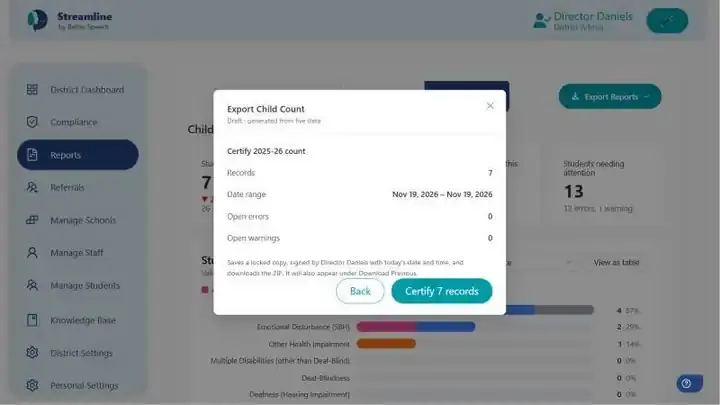
Timelines met: evaluation, IEP meeting, annual review and reevaluation dates on or before their deadlines.
Paper trail complete: consent, meeting notices, prior written notice and procedural safeguards.
IEP complete: every element of 34 CFR 300.320, with measurable goals.
Services verified: logs that match the minutes written.
Progress reported: reports sent to families on schedule.
Frequently asked questions about IEP compliance
What is an IEP compliance checklist?
It is a list of the legal requirements every IEP and every special education file must meet, including timelines, notices, required contents, service delivery and progress reporting, used to review files before an audit.
How long does a school have to complete an initial evaluation?
Under IDEA, within 60 days of receiving parental consent, unless the state sets its own timeframe. Check your state's rules, since many differ.
How often must an IEP be reviewed?
At least once a year. Students must also be reevaluated at least once every three years unless the parent and district agree a reevaluation is unnecessary.
Do state timelines replace the federal ones?
States can set their own timeframes for some steps, such as the initial evaluation. Your district must follow your state's rules, which cannot provide less protection than IDEA.
What happens if a district misses an IEP deadline?
Consequences vary. A missed deadline can lead to a state complaint, a finding with corrective action or, where services were not provided, compensatory services for the student.
Conclusion
An IEP compliance checklist turns scattered deadlines into a routine your whole team can run. To see how Streamline helps your team write stronger goals in less time, Book a demo.


